Sound familiar?Toronto
- The call
- The crossbar on the loading-dock door barely returns anymore. Someone has to lean into it with a shoulder, and twice this month it has stuck half-latched, propped by whatever was nearest.
Someone at the front counter always has to unlock the side door by hand before the lunch rush, because the round doorknob out there was never meant to be an exit for a room this size.
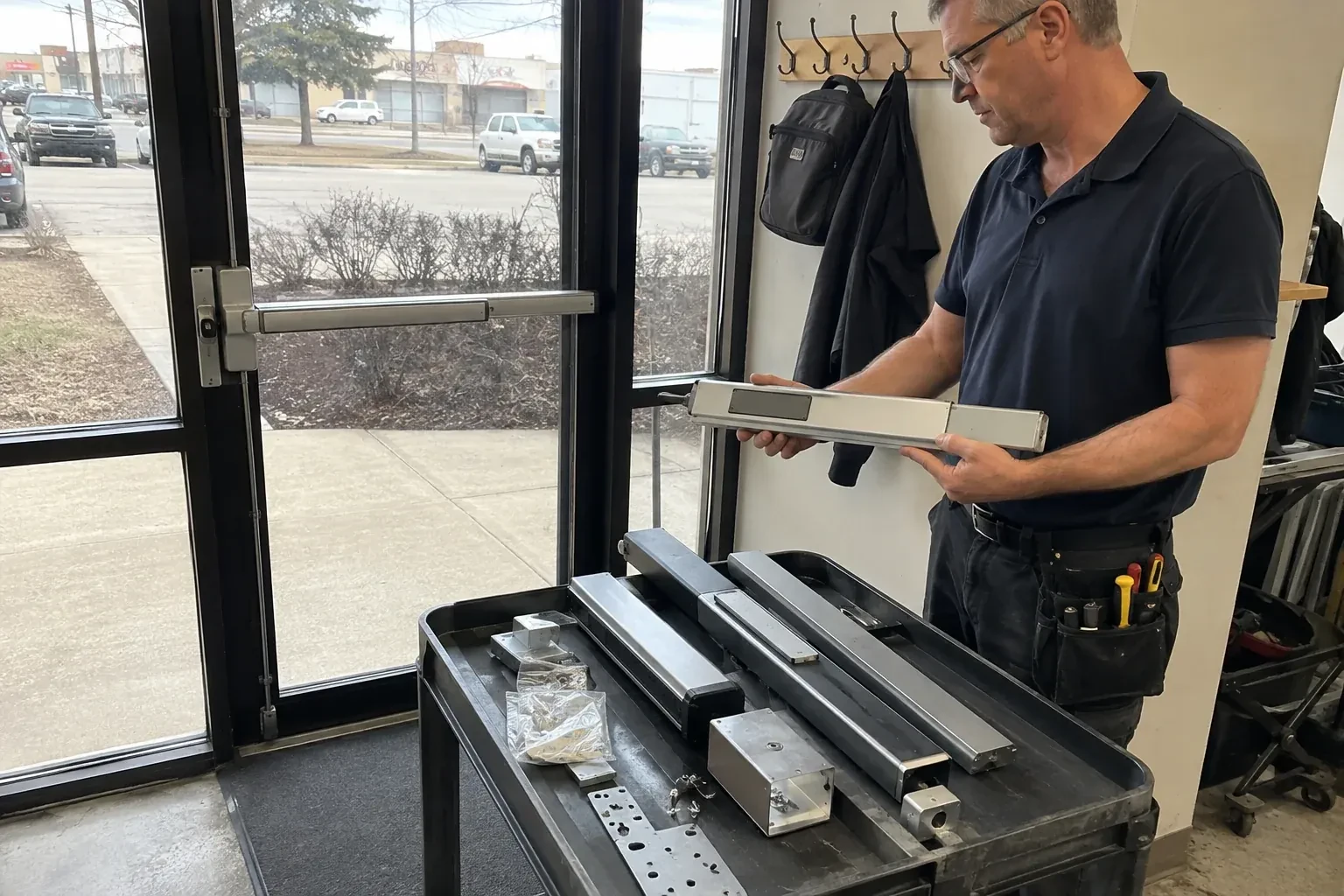
Which device goes on a door depends on what the door already is. A single interior door usually takes a rim exit device and a simple pull or lever outside. Listed fire-exit hardware covers many tall, narrow-stile and fire-rated openings too, so a mortise or vertical-rod device is chosen for its latching arrangement or the door's own preparation, not from height or fire rating alone, and a fire-rated opening can never be held open by a mechanical dogging function. Reading the door correctly before ordering hardware is most of the job; fitting it well is the rest.
Sound familiar?Toronto
Panic & Exit Hardware · Toronto
Scene 1
Single doors and pairs get assessed differently from the first look. On a pair, the locksmith checks whether a mullion currently splits the opening, whether a coordinator is already fitted, and whether the leaves close independently or in a set order. This decides whether the project is a straightforward device swap on each leaf or something larger, such as removing a mullion and fitting a compatible replacement latching arrangement to turn two narrow doors into one wide exit. Getting this right at the assessment stage avoids ordering hardware for a single door when the opening is really two leaves working together.
Scene 2
With the assessment done, the locksmith matches a device family to the door: a rim exit device for most single doors, a mortise device where a heavier-duty case suits the opening, or a vertical-rod device where latching is needed at both the top and bottom of the frame. Fire-rated openings take fire exit hardware specifically listed for that duty, never a standard panic device pressed into a role it was not built for, and listed rim fire-exit hardware covers a wide range of those openings on its own. The chosen device is matched to the door's width, handing and existing preparation before it is ordered.
Scene 3
Whoever holds the dogging key or keyed dogging cylinder now knows what it does and, just as importantly, when not to use it: a door in a fire separation keeps its active latch at all times, so dogging belongs on openings where that restriction does not apply. Staff who prop doors for deliveries or busy periods have a legitimate tool for that instead of wedging the door with whatever is nearest, and the building keeps control over who can use it.
What shapes the quoteBloordale Gardens Lock & Key Co.
FeesSame any hour
Occupant load is calculated from the floor area and the intended use of the room, using published factors for that occupancy type, rather than a headcount taken on a busy night. A building official or a locksmith familiar with the calculation can work through it for a specific room, and the result is what decides whether the exit doors serving that room need a releasing device.
No additional fastening should stay on an exit door that does not release the same way the primary device does. A hasp, padlock or separate deadbolt added at some point for extra security is a common finding on an older door, and removing or replacing it with something that releases under the same push is part of bringing that opening back to a single, reliable exit.
Yes. An exit alarm module sounds when the device is used, which tells staff a door meant to stay closed has been opened, but it does not add any resistance to the push that releases the latch. The alarm is a notification layer on top of hardware that still opens under one motion, which is why it suits stockroom, dock or perimeter doors where entry through that opening should be rare.
TorontoOntario
Panic & Exit Hardware · Bloordale Gardens, Eringate, Etobicoke, Glen Agar, Islington, Princess Margaret, Thorncrest Village, West Deane Park
Every square is one home in a hundred.
On-site assessment
Someone at the front counter always has to unlock the side door by hand before the lunch rush, because the round doorknob out there was never meant to be an exit for a room this size.
(289) 804-4797, open 24/7.
On-site assessment preferred · (289) 804-4797, open 24/7